Bluefin, OpenCode, and Hex: One Container, One Brief
I’m good at turning “install a compiler” into “fiddle with my Linux setup.” I do the fiddling in one Debian container now and leave Bluefin DX stock. Hex stays on the desktop. OpenCode gets a 27-line AGENTS.md, which is short for me.
1. Keep the host boring
I run ghcr.io/ublue-os/bluefin-dx:stable without layering any rpm-ostree packages. Bluefin handles the Wayland desktop, PipeWire, Vulkan, Flatpaks, and atomic updates.
I called my Distrobox dev. It’s Debian 13 on rootless Podman. OpenCode runs there, and mise supplies Rust, Go, Node, Python, and gh.
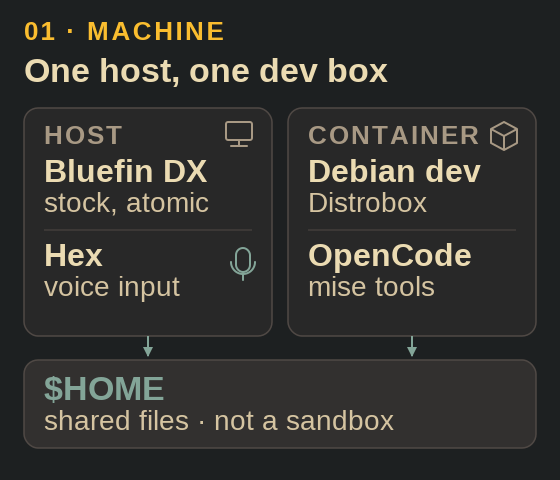
Create dev on the host, then enter it:
distrobox create --name dev --image docker.io/library/debian:13 --yes
distrobox enter dev
Install the toolchain and OpenCode V2 inside dev. I use full paths so I can leave .bashrc alone:
sudo apt-get update && sudo apt-get install -y ca-certificates curl git
curl -fsSL https://mise.run | sh
"$HOME/.local/bin/mise" use -g rust go node python gh
curl -fsSL https://opencode.ai/v2/install | bash -s -- --no-modify-path
"$HOME/.local/bin/mise" exec -- "$HOME/.opencode/bin/opencode" --version
Drop --version to launch. On the host, I use this Bash function to start OpenCode in dev:
opencode() {
  distrobox enter dev -- "$HOME/.local/bin/mise" exec -- \
    "$HOME/.opencode/bin/opencode" "$@"
}
mise exec puts the tools on PATH in dev. I don’t need mise activate on the host. If an OpenCode service is already running there, I pass --standalone to start a private server in dev.
Distrobox shares $HOME. I can use the same checkout from either shell. I can wreck it from either shell, too. This isn’t a sandbox.
2. Keep the brief short
OpenCode V2 reads ~/.config/opencode/AGENTS.md alongside the project’s instructions. I put my habits in the global file and leave build commands in the repo that uses them.
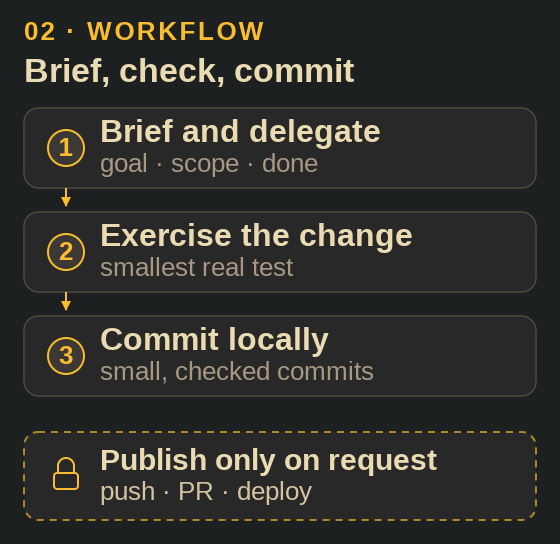
The subagent didn’t sit through the conversation that got me here. I write down what to do, what not to touch, and how I’ll know it’s done. Sometimes that’s when I find out I don’t know what I want yet.
Then I want a check that could actually fail. Run the test, try the command, or open the page. Tell me what passed, failed, or didn’t run. Make small local commits once the checks pass.
No pushing, opening or merging PRs, or deploying until I ask. A push to this blog’s main publishes it. If I’m going to publish a sentence I regret, I’d like to do it myself.
If I keep catching the same bug, a test has a better shot than line 28 of AGENTS.md. A type or lint rule will do, too. Lauren Tan makes the case in All Code Is Slop (Except Mine).
Read the exact 27-line AGENTS.md
# Writing

- Be terse. Cut filler, hedging, and meta-commentary.
- Lead with subject and verb, never `What ...` or `The way ...` openers.
- State reality directly: separate what exists now from target/production behavior.

# Delegation

- Primary plans, briefs, spot-checks (1–2 read-only checks), and summarizes. Delegate reads/search to `explore` and multi-step research, skill lookups, edits, builds, and commits to `general`.
- Act directly only when the whole turn takes 1–2 tool calls with no edit-build-check loop.
- After launching background subagents, end the turn—don't fetch docs or build harnesses alongside them. Send revisions to the subagent's `sessionID` instead of patching its output yourself.
- Briefs state goal, scope, gotchas, and definition of done (`stop and report`). Read-only agents may share a checkout; concurrent writers get separate worktrees and isolated ports/DBs.

# Verification & Git

- Exercise changed behavior with the smallest real check (prefer integration/regression tests over brittle unit tests); report what passed, failed, or wasn't run.
- Turn recurring bugs or agent mistakes into types, lint rules, or tests—not more prose or comments.
- Commit implementation edits locally in small, checked, review-order commits (`<ticket>: <imperative summary>` when known; *why* and constraints in body).
- Push, open/merge PRs, deploy, delete, squash, or rewrite history only when explicitly asked, gated on passing checks with `&&` (lead PRs with blast radius, review order, and checks).

# Code & Web

- Keep the core small and local: plain data and functions, explicit control flow, concrete code first—extract only after repetition, and cut unrequested features or layers.
- Respect Chesterton's fence before deleting, and don't copy repo tech debt or hacks into new code.
- Fix root causes instead of patching with timers, retries, casts, or suppressions; comment only non-obvious invariants and external constraints, never to excuse a workaround.
- Measure before optimizing; avoid needless allocations and indirection.
- Default new standalone UIs/reports (when a repo has no stack) to [Oat](https://oat.ink) (`@knadh/oat`), semantic HTML, and accessible inline SVG.
Keep the primary session focused
I send explore to look things up. I want the answer in the main session, not all the grep output. Readers can share a stable checkout. Writers get separate git worktrees, plus their own ports or databases if they’d otherwise collide.
Pick a cheaper model for subagents
I don’t need my priciest model to find a file. Here’s how to give the subagents a cheaper one in the global opencode.jsonc. Pick a model and variant you see in /models:
{
  "$schema": "https://opencode.ai/config.json",
  "agents": {
    "general": {
      "model": "opencode-go/deepseek-v4.1-flash#high"
    },
    "explore": {
      "model": "opencode-go/deepseek-v4.1-flash#low"
    }
  }
}
Prior art. I borrowed most of it: Carson Gross’s Grug, Locality of Behavior, Chesterton’s fence, Mitchell Hashimoto on small increments, and Casey Muratori’s Semantic Compression on starting with concrete code.
3. Keep the audio local
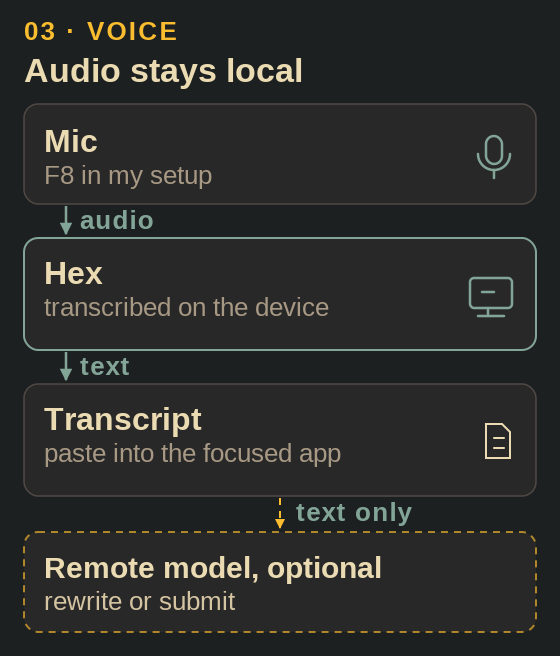
Install Hex on the host, then open it from the app launcher:
curl -fsSL https://anoma.ly/hex/files/install-linux.sh | sh
Parakeet runs on my Vulkan iGPU. Silero VAD detects speech, and I use Labs for spoken formatting and filler-word removal. I bound F8; Hex defaults to Ctrl+Alt+Space on GNOME.
Hex transcribes on-device. The audio stays here. If I use a remote model to rewrite a dictation or submit it to one in OpenCode, that model gets the transcript.
Dictation makes it easier to write a long prompt. I’m trying not to take that as encouragement.